Buying a house in Spain as a non-resident is entirely possible and, with the right guidance, can be a smooth process. At RH Privé Estates, we work daily with international buyers seeking a second home, a long-term investment or a new lifestyle on the Costa del Sol. Being a non-resident does not complicate the purchase itself as much as it affects document preparation, proof of funds and tax compliance before and after completion.
In this 2026 guide, we explain buying a house in Spain as a non-resident from a practical perspective: the main steps, required documents, applicable taxes and ongoing obligations once you become the owner.
What “non-resident” means when buying in Spain
A non-resident is generally someone who does not have tax residency in Spain. This means you do not pay Spanish tax on your worldwide income, but only on income generated in Spain (for example, rental income). This status does not prevent you from purchasing property, but it does affect your tax obligations as an owner, such as Non-Resident Income Tax (IRNR).
Spain also applies strict anti-money laundering controls and identity verification procedures. As a result, non-resident buyers are often required to provide additional supporting documentation, particularly if they live and work abroad.
Before you start: what to prepare to avoid missing opportunities
In dynamic markets, decisions are made quickly. If you are considering buying a house in Spain as a non-resident, it is advisable to prepare key elements in advance. Before committing to a property, non-resident buyers should ideally have three elements prepared: tax identification, banking arrangements and documented proof of funds.
The NIE: your tax identification number in Spain
The NIE (Foreigner Identification Number) is essential when buying property. It is required to sign the title deed, pay taxes, open a bank account and arrange utilities. It can be requested at a Spanish consulate in your country of residence or directly in Spain.
Spanish bank account: not always mandatory, but highly recommended
Opening a Spanish bank account is not strictly compulsory, but it greatly simplifies payments, taxes and direct debits. Banks usually require the NIE, passport, proof of address and, in some cases, evidence of income.
Source of funds and AML compliance
In 2026, proof of the source of funds is standard practice. It is not an obstacle if properly documented. Buyers are typically asked to provide evidence supporting the source of their money in compliance with anti-money laundering regulations (AML).
When buying a house in Spain as a non-resident, professional guidance at this stage helps reduce delays, prevent documentation issues and ensure a smoother transaction process.
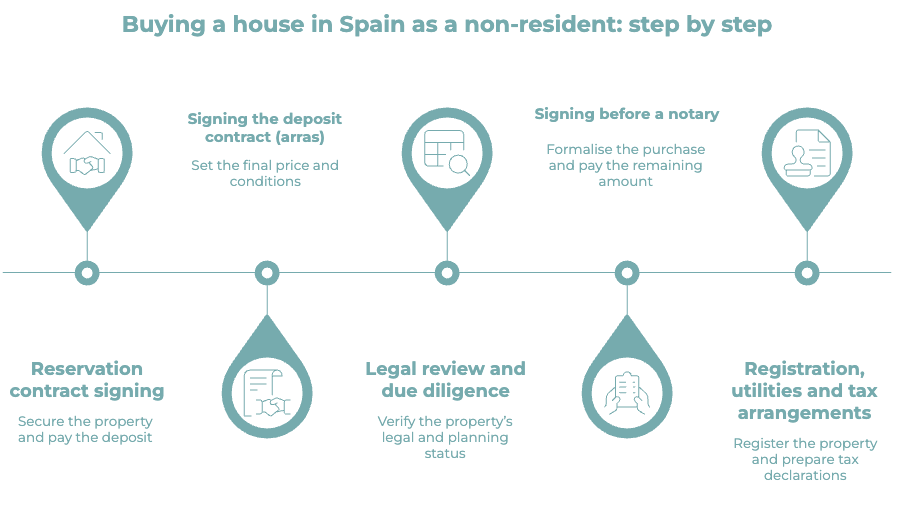
Step by step: buying a house in Spain as a non-resident
The purchase process in Spain generally follows a clear structure. Understanding what is signed and when payments are made is key.
Reservation agreement: securing the property
Once you choose a property, it is common to sign a reservation agreement and pay a deposit to remove it from the market while checks are carried out. For non-residents, this phase often requires careful coordination regarding the NIE, bank account, powers of attorney and international transfers.
Private purchase contract (arras): terms and deadlines
The next step is usually signing a private purchase contract, where the final price, timelines and conditions are agreed, and a percentage of the price is paid. This stage is particularly important when buying a house in Spain as a non-resident, as contractual clarity and legal review help prevent cross-border complications.
This contract is legally binding. It defines deadlines, penalties and obligations for both parties. In higher-value transactions, legal advice and a full document review are strongly recommended.
Legal review and due diligence
Before signing at the notary, it is essential to verify the property’s registration status, ensure it is free of charges, confirm the seller’s ownership and check that local taxes, community fees and utilities are up to date. Urban planning compliance should also be reviewed when applicable.
For remote buyers, this stage provides reassurance through documented evidence from the Land Registry, Cadastre and relevant authorities.
Notary signing: completion of the purchase
The transaction is formalised by signing the public deed before a notary. At this stage, the remaining balance is paid, the keys are handed over and the relevant taxes are settled.
If the buyer cannot attend in person, completion can take place through a duly granted power of attorney. This mechanism is frequently used when buying a house in Spain as a non-resident, allowing the transaction to proceed smoothly without the need to travel.
After completion: registration, utilities and tax organisation
Following the notary signing, the property must be registered at the Land Registry. Utility contracts are transferred and non-resident tax obligations must be organised accordingly.
Transparency and buyer protection under Spanish Law 12/2023
Spanish law 12/2023, of 24 May, strengthens transparency and consumer protection in property purchase and rental transactions. Developers, owners and estate agents must provide complete, objective, accurate and accessible information, and misleading or insufficient advertising is prohibited.
Prospective buyers may request, before signing or paying any deposit, essential information in durable form, including seller and intermediary identification, financial conditions and key property details such as habitability certificates, surface area, age, installations, energy performance certificate and registry information regarding charges or encumbrances.
For non-resident buyers, this transparency significantly reduces uncertainty and enhances decision-making security.
Taxes and costs for non-residents in 2026
When buying a house in Spain as a non-resident, understanding the applicable taxes and associated costs from the outset is essential for accurate financial planning. The purchase tax does not change due to non-resident status; it depends on the type of property and the autonomous region.
Resale property: Transfer Tax (ITP)
When buying a resale property, Transfer Tax (ITP) applies. Rates vary by region and generally range between 6% and 10%.
New build property: VAT (and, where applicable, Stamp Duty)
For new build properties, VAT is generally applied at 10%. In certain cases, Stamp Duty (AJD) may also apply, depending on the region and transaction structure. As a general guideline, it should be budgeted for from the beginning, together with notary, land registry, administrative and legal costs.
Typical transaction costs
Additional costs typically include notary fees, Land Registry fees, valuation (if financing is involved) and professional advisory fees. As a general estimate, buyers should budget approximately 10%–12% on top of the purchase price to cover taxes and expenses.
Ongoing tax obligations as a non-resident owner
Non-residents are taxed in Spain under Non-Resident Income Tax (IRNR) when they obtain income in Spain, and its management is carried out, among others, through forms 210/211.
Regarding tax rates, the Tax Agency generally establishes 19% for EU/EEA residents (with nuances) and 24% for the remaining taxpayers under IRNR without a permanent establishment.
Practical note: IRNR rules may vary depending on whether the property is rented, used privately, or covered by a double taxation treaty. Therefore, it is advisable to plan ahead with specialised advice.
Other taxes: Property Tax (IBI) and, in certain cases, Wealth Tax
Additionally, owners must pay annual Property Tax (IBI). Depending on the property’s value and personal circumstances, Wealth Tax or other reporting obligations may also apply. Each case should be reviewed individually.
Buying on the Costa del Sol with specialised guidance
At RH Privé Estates, we work with international buyers who value security, clarity and efficiency. Beyond presenting properties, we coordinate a process aligned with your circumstances, including remote signings, international banking coordination and multilingual communication.
Our multidisciplinary team provides comprehensive support, including legal advice throughout the transaction process. We also collaborate with international banks that can assist you in your native language with financing arrangements.
If you are considering buying a house in Spain as a non-resident on the Costa del Sol, we can organise a private viewing, prepare documentation in advance and structure a realistic timeline so that completion takes place with full confidence.
You can contact us to ensure a smooth and well-guided purchase process. We will be delighted to assist you every step of the way.
FAQs about buying a house in Spain as a non-resident
Can I buy property in Spain without being a tax resident?
Yes. Non-residents can purchase property, but they will have specific tax obligations as owners.
Is the NIE mandatory?
Yes. The NIE is required to sign the deed, pay taxes and complete related procedures.
Can I sign without travelling to Spain?
In many cases, yes. A power of attorney can be granted to allow a representative to sign on your behalf.
How long does the process take when buying a house in Spain as a non-resident?
It depends on the complexity of the transaction and documentation readiness. Preparing documents in advance helps ensure a smoother and faster process.