
Buying a property involves much more than finding a home you like and checking whether you can afford the monthly mortgage repayments. Before reaching that stage, there is one key question that can influence the entire process: how much do you need to save to buy a property?
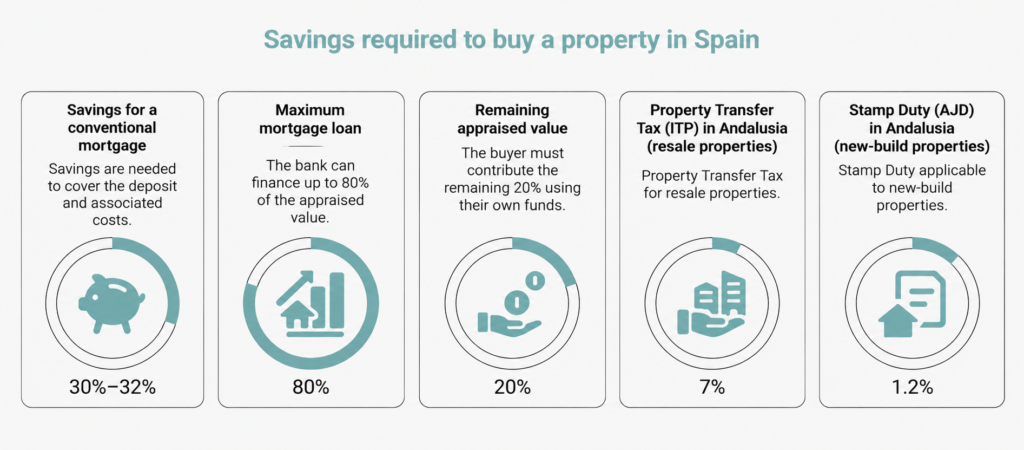
As a general starting point, if you are taking out a conventional mortgage in Spain, it is advisable to have approximately 30% to 32% of the property’s purchase price in savings. However, the final amount will depend on the type of property, the region where it is located, the financing available and the buyer’s individual circumstances.
Why so much? Because there are two separate amounts to consider. First, there is the portion of the purchase price that the bank will not normally finance. Then there are the taxes and other costs associated with the purchase.
The Bank of Spain explains that the amount of a mortgage loan is directly linked to the property’s valuation and that financing can normally reach up to 80% of that value. This means that, in a conventional transaction, buyers should be prepared to contribute approximately the remaining 20% from their own funds.
We must also factor in purchase taxes and other associated costs. For example, second-hand properties in Andalusia are generally subject to Property Transfer Tax (ITP) at a rate of 7%. Newly built properties, on the other hand, are subject to VAT and Stamp Duty (AJD), the standard rate of which in Andalusia is currently 1.2%.
Therefore, working out how much property we can afford does not start with calculating the mortgage. It starts with calculating our savings.
How much do you need to save to buy a property?
As a simple rule of thumb, we can start with the following calculation: approximately 20% of the purchase price to cover the portion that the mortgage will not usually finance, plus an additional amount for taxes and other purchase costs.
Our guide to the property purchase process recommends allowing for approximately 10% to 12% of the purchase price in additional taxes and expenses as a practical reference. However, the exact amount will vary depending on whether the property is a new build or a resale and the specific circumstances of the transaction.
This is where the commonly quoted figure of around 30% to 32% of the property’s value in savings comes from.
However, this should be understood as a general guideline rather than a mathematical formula that applies to every buyer.
Imagine a property priced at €300,000. If the bank finances 80% of the amount considered for the transaction, the mortgage would be approximately €240,000, leaving us to contribute €60,000 towards the purchase price. Taxes and other acquisition costs would then need to be added to this amount.
Having €60,000 in savings, therefore, does not necessarily mean that we can afford to buy a €300,000 property. We must also retain enough liquidity to cover the entire transaction.
This is precisely where one of the most common mistakes made by prospective buyers arises: calculating their budget based solely on the deposit and forgetting about the remaining costs.
The down payment: why is 20% so common?
Financial institutions assess every mortgage application individually. Having a particular income does not guarantee that we will be able to borrow a specific amount, as the bank will consider our ability to repay the loan, employment stability, level of indebtedness, age, assets and other financial commitments.
The property we intend to buy will also be assessed.
The valuation is particularly important because it establishes the property’s value for mortgage lending purposes. The Bank of Spain reminds buyers that the property must be valued before the mortgage is formally granted and that the final lending decision depends on both this valuation and the borrower’s ability to repay.
As a general practice, mortgage financing stands at around 80%, which is why the remaining 20% is commonly referred to as the deposit that the buyer must contribute.
However, we should approach this calculation with caution.
If we find a property priced at €500,000 and obtain financing equivalent to 80%, we might assume that contributing €100,000 plus the associated costs will be enough. In reality, the amount the bank agrees to lend will depend on its assessment of our application and the property’s valuation.
For this reason, we recommend assessing the available financing before committing a significant amount towards a reservation fee or arras deposit, particularly when the purchase depends on obtaining a mortgage.
This is also the right time to understand the steps involved in buying a property, from legal and Land Registry checks to the mortgage, title deed and applicable taxes.
Understanding the entire process before making an offer helps us establish how much capital we need to keep available and prevents us from using all our savings simply to cover the purchase price.
Taxes change how much you need to save
The answer to how much you need to save to buy a property can vary considerably depending on whether you are purchasing a new build or a second-hand property.
How much should you save to buy a second-hand property in Andalusia?
Second-hand properties are not subject to VAT. Instead, the transaction is generally subject to Property Transfer Tax (ITP).
In Andalusia, the standard ITP rate for property purchases is currently 7%.
This means that a second-hand property valued at €300,000 would incur an ITP bill of €21,000, based solely on the standard rate and using a simplified example.
If we also need to contribute €60,000 because we are obtaining 80% mortgage financing, we would already need €81,000 to cover the buyer’s contribution and ITP, before taking any other transaction costs into account.
For a €500,000 property, the initial calculation would be €100,000 for the 20% not covered by the mortgage and €35,000 in ITP at the standard rate. This brings the total to €135,000, still excluding other expenses.
These examples demonstrate why it is important not to confuse the mortgage deposit with the total savings required to buy a property.
Andalusia also offers reduced ITP rates in certain circumstances involving the purchase of a primary residence, subject to property value limits and personal eligibility requirements. For example, tax benefits are available for certain main residences and specific categories of buyers.
We should not assume that we qualify for these reductions without first assessing our individual circumstances. These limits are particularly relevant for high-value transactions, such as many of those found in the Costa del Sol’s premium property market.
How much should you save to buy a new-build property?
The tax situation is different when buying a new-build property.
The first sale of a property by a developer is subject to VAT rather than ITP. In the usual case of a newly built residential property, buyers must allow for 10% VAT, in addition to the applicable Stamp Duty (AJD). In Andalusia, the standard AJD rate is currently 1.2%.
Let us consider another example: a new-build property priced at €300,000. If the buyer contributes 20% of the purchase price because they obtain 80% mortgage financing, they would initially need €60,000. On top of this, they would need to pay €30,000 in VAT and, applying the standard rate, €3,600 in AJD.
These three items alone would total €93,600.
Buyers should also budget for any other applicable purchase costs.
This is why, when purchasing a new-build property with a conventional mortgage, the savings required can easily exceed 30% of the purchase price.
What other costs should you take into account?
Taxes are the most significant expense after the deposit, but they are not the only costs to consider.
Buying a property involves various legal, administrative and financial procedures. Depending on the transaction, we may need to account for the valuation, certain conveyancing costs, Land Registry registration, notarial copies, legal advice or administration services, as well as other expenses specific to the purchase.
It is important to distinguish between property purchase costs and mortgage arrangement costs.
Since Spanish Law 5/2019 came into force, the allocation of mortgage arrangement costs has changed. According to the Bank of Spain, the borrower pays for the property valuation, while the lender covers the notary, Land Registry, tax and administration costs associated with arranging the mortgage.
This does not mean that the bank pays every expense related to buying the property. The Bank of Spain expressly clarifies that this allocation applies to mortgage formalisation, not to the property purchase itself.
This distinction is essential when preparing our budget.
Our advice is not to approach the purchase with savings calculated down to the last euro. A property transaction should leave us with some financial breathing room, particularly if we intend to furnish the property, carry out improvements or simply maintain an emergency fund after receiving the keys.
Examples: how much should you save depending on the property price?
Let us look at several scenarios to better understand the figures. We will assume conventional mortgage financing of 80%. These are illustrative examples rather than personalised budgets.
For a property priced at €250,000, the 20% not covered by the mortgage would amount to €50,000. If it were a second-hand property in Andalusia and the standard ITP rate of 7% applied, a further €17,500 would be payable. The initial total would therefore be €67,500, excluding the remaining costs.
For a property priced at €400,000, the 20% contribution would be €80,000. If it were a second-hand property in Andalusia, ITP at the standard rate of 7% would add another €28,000. The initial amount required would therefore rise to €108,000, plus other acquisition costs.
For a property valued at €750,000, obtaining 80% financing would require a personal contribution of €150,000. If the property were second-hand and the standard Andalusian ITP rate of 7% applied, a further €52,500 would need to be added. The buyer’s contribution and tax would already total €202,500.
If that €750,000 property were a new build, the initial calculation would be different: €150,000 in personal funds, €75,000 in VAT and €9,000 in AJD at 1.2%. This would bring the total to €234,000, before other applicable expenses.
These calculations help explain why the percentage of savings required is particularly important when buying luxury property: every percentage point represents a considerable amount of capital.
Can you buy a property without saving 20%?
Yes, there are circumstances in which mortgage financing can exceed the usual percentage, but we should not consider a 100% mortgage to be the norm.
One of the most relevant exceptions currently available is the ICO Guarantee Scheme for the purchase of a first home by young people and families with dependent children.
According to the ICO, this programme can help buyers obtain a loan of up to 100% of the lower of the property’s valuation and purchase price, provided they meet the eligibility requirements and the lender approves the application. Taxes and other expenses are not included in this 100%.
The programme also remains relevant in 2026. An amendment published in Spain’s Official State Gazette (BOE) on 2 July 2026 extended the deadline for completing these transactions to 31 December 2027.
This is an important distinction.
Someone eligible for one of these schemes may not need to have the full 20% conventional deposit available, but they will still need funds to cover taxes and other costs that are not included in the financing.
Furthermore, meeting the requirements of a guarantee scheme does not oblige a bank to grant a mortgage. The lender will continue to apply its own creditworthiness and risk assessment criteria.
For this reason, it is useful to establish exactly what financing is available to us before beginning our property search.
Having the deposit does not necessarily mean you are ready to buy
This is a point that is sometimes overlooked.
Suppose we have saved exactly enough to cover the deposit, taxes and other expenses. Does that mean we should use all our savings to buy the property? Not necessarily.
A property comes with ongoing costs after completion, including community fees, utilities, insurance, recurring taxes, maintenance and potential repairs. In a premium residential development, there may also be shared facilities and services whose costs need to be included in our financial planning.
Personal circumstances may also create additional financial needs unrelated to the property itself.
Whenever possible, we therefore consider it healthier to distinguish between the capital allocated to the purchase and the financial cushion we want to retain afterwards. Buying the right property should not mean being left without liquidity.
This becomes even more important for international buyers or those purchasing a second home on the Costa del Sol, as they may have additional planning, maintenance and property management requirements to consider.
How to prepare your savings before starting your property search
Before deciding on our maximum budget, we should work backwards.
First, we calculate how much capital we have available without compromising our emergency fund. We then estimate the taxes applicable to the type of property we are considering. Next, we assess how much a bank might be willing to lend based on our financial circumstances. Only then can we establish a realistic property price range.
This approach helps us avoid one of the most frustrating situations in a property purchase: falling in love with a home only to discover later that, although we can afford the monthly mortgage repayments, we do not have the initial capital required to complete the transaction.
We should also understand from the outset what happens once we find the right property: reservation, legal checks, arras deposit, financial documentation, valuation, mortgage approval, completion and registration.
If you would like to explore this stage in more detail, we have also explained the buying process with RH Privé Estates and how we support buyers throughout the different stages of their property purchase.
Good financial planning and a well-organised buying process should go hand in hand. With RH Privé Estates by your side, the entire experience can be much more rewarding.
FAQs about how much you need to save to buy a property
How much do you need to save to buy a property worth €200,000?
If we obtain a conventional mortgage covering 80% of the purchase price, we would need to contribute approximately €40,000 to complete the purchase. Taxes and other expenses must be added to this amount. As a general guideline, therefore, having around 30% to 32% of the purchase price in savings provides a useful starting point, although the actual amount will depend on the property and the autonomous community in which it is located.
Does the bank always finance 80% of the property’s value?
No. The 80% figure is a common guideline, not a right that every buyer is entitled to. The lender assesses our financial circumstances, repayment capacity and the property that will serve as collateral. The Bank of Spain states that lenders do not normally grant more than 80% of the property’s valuation.
Do you need more savings to buy a new-build property?
You may do. A new-build property is generally subject to 10% VAT and, in Andalusia, 1.2% AJD at the standard rate. A second-hand property in Andalusia is generally subject to ITP at 7%. As a result, the tax treatment can mean that the initial amount required differs between the two types of property.
Is it possible to obtain a 100% mortgage?
It may be possible in certain transactions, and specific schemes can help buyers obtain financing above the usual 80%. Currently, the ICO Guarantee Scheme for eligible young people and families with dependent children can allow the loan to reach 100% of the lower of the property’s valuation and purchase price, subject to eligibility requirements and the bank’s approval.
Are expenses included in a 100% mortgage?
We should not assume that they are. Under the ICO Guarantee Scheme, for example, the limit is based on the lower of the property’s valuation and purchase price and does not include taxes or other expenses. Even if we manage to finance the entire purchase price, we still need to have savings available.
What taxes do you pay when buying a property in Andalusia?
In general, a second-hand property is subject to ITP at 7%. A new-build property is subject to VAT, and the purchase deed is also subject to AJD, which has a standard rate of 1.2% in Andalusia. Reduced rates are available in certain circumstances, so each transaction should be assessed individually.
Is it advisable to spend all your savings on the deposit?
Whenever possible, no. In addition to the money needed to complete the purchase, it is advisable to retain some liquidity to cover ongoing expenses, maintenance and unexpected costs. The fact that a bank considers a transaction viable does not necessarily mean that using all our available assets is the best financial decision.
