
Talking about sustainability in real estate has become increasingly common. Today, almost every property development mentions terms such as energy efficiency, respect for the environment, responsible design or low environmental impact. However, the question is inevitable: are we witnessing a real transformation in the sector, or simply another marketing strategy?
From our experience at RH Privé Estates, with more than 30 years of consolidated expertise, we believe that sustainability only makes sense when it translates into concrete, measurable and consistent decisions throughout the entire real estate process. It is not enough to communicate an intention; it must be demonstrated through design, construction, resource management, the relationship with the environment and the way a company operates on a daily basis.
Our commitment is expressed through the concept of Eco Luxury Developments, a way of understanding luxury where quality, wellbeing, efficiency and respect for the environment do not compete, but reinforce one another. We lead the development of sustainable luxury homes through a plan that is continuously reviewed and improved, fully integrated into the design and construction process of our projects.
What sustainability in real estate really means
Sustainability in real estate should not be limited to installing a few efficient elements or using attractive language in a marketing campaign. A truly sustainable developer must act on three levels at the same time: environmental, social and economic.
From an environmental perspective, this means reducing energy consumption, optimising water use, minimising waste, protecting ecosystems and using responsible materials. From a social perspective, it involves creating healthy, comfortable spaces designed to improve the quality of life of those who live in them. From an economic perspective, sustainability must also translate into durability, maintenance efficiency and long-term value.
For this reason, when a developer claims to be sustainable, it is worth asking several questions: what measures are implemented from the initial design stage? How is water managed? What materials are used? How is the impact on the land reduced? What corporate commitments exist beyond each individual development? Only when there are clear answers can we speak of real sustainability in real estate.
At RH Privé, we summarise it simply: it is not what we say, it is what we do. Sustainability must be present from the very first line of a project to the everyday life within the home.
Actions a sustainable developer can take
A developer aiming to be truly sustainable must begin with planning. Before building, it is essential to study the land, its orientation, vegetation, relationship with the climate and its impact on the community. This preliminary analysis allows for smarter decisions and reduces the need for artificial solutions later on.
Energy efficiency
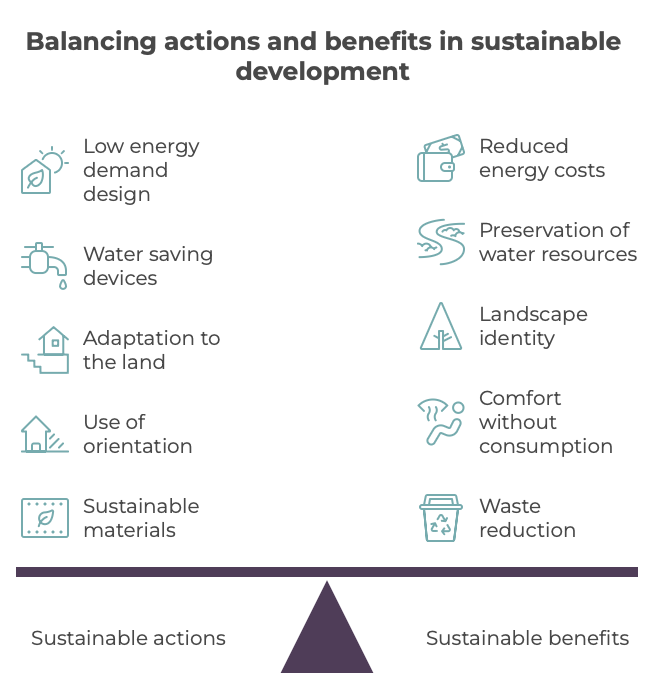
One of the most important actions is committing to energy efficiency. This involves designing buildings with low energy demand, incorporating efficient heating, cooling and hot water systems, using LED lighting, improving thermal insulation, installing high performance windows and, whenever possible, integrating renewable energy sources such as photovoltaic panels.
Water efficiency
Efficient water use is also essential, especially in areas such as the Costa del Sol, where pressure on water resources is increasingly evident. A sustainable developer must install saving devices, consider reuse systems, design gardens with climate adapted species and avoid solutions that require excessive or inefficient consumption.
Protecting the ecosystem
Building should not mean imposing a project on the environment, but engaging with it. This means adapting design to the land, preserving the landscape identity, regenerating spaces when possible and choosing landscaping that is consistent with local vegetation.
Bioclimatic design
Bioclimatic design also plays a key role. Taking advantage of orientation, cross ventilation, natural shading, thermal mass, courtyards, light colours and traditional architectural elements helps reduce energy consumption without compromising comfort. Mediterranean vernacular architecture offers many solutions that are once again highly relevant today.
Material and resource management
Finally, a sustainable developer must address the management of materials and resources. This includes using sustainable materials, reducing waste, controlling erosion, preventing pollution, recycling inert materials and monitoring resource use to extend their lifecycle.
How we apply it at RH Privé: Eco Luxury Developments
At RH Privé, we understand sustainable real estate as a responsibility. We do not conceive a high-end home solely as a beautiful, exclusive and well-located space; it must also be efficient, healthy, durable and respectful of its surroundings.
Through our Eco Luxury Developments, we integrate passive and active measures aimed at reducing energy consumption and improving wellbeing. These include high efficiency aerothermal systems for hot water and climate control, photovoltaic panels for renewable energy generation, LED lighting, high performance windows with thermal break and advanced energy and acoustic performance, as well as monitoring and control systems.
We also incorporate occupancy, lighting, ventilation and CO₂ sensors to promote smarter space management. Our goal is not only to meet regulatory requirements, but to move towards 360º sustainable construction, economically, socially and environmentally.
In terms of water, we implement solutions designed to reduce consumption both indoors and in communal areas. We install efficient devices, promote the use of local or climate adapted vegetation, consider rainwater reuse for irrigation and other purposes, and opt for outdoor saltwater pools to avoid harmful chemicals.
Regarding the ecosystem, our architectural team analyses the characteristics of the land to adapt to it whenever possible. We consider ourselves responsible for the environment in which our homes are located, working to generate a positive impact during construction and throughout the entire lifecycle of the project.
Bioclimatic design: when architecture works with the climate
One of the most interesting aspects of sustainability in real estate is that many of its solutions are not new. On the Costa del Sol, traditional architecture already understood the importance of protection from the sun, creating shade, natural ventilation and using materials capable of stabilising indoor temperatures.
At RH Privé, we take vernacular architecture as a reference and combine it with contemporary solutions. We apply overhanging roofs to shade façades and openings, protect windows with shutters and curtains, incorporate vegetation in courtyards and surroundings, and use shading systems adapted to each orientation.
We also pay special attention to the building envelope. Walls with good thermal mass, proper insulation, efficient windows and a balanced proportion between solid and open spaces help reduce energy loss and improve indoor comfort.
Cross ventilation, light coloured façades and roofs, as well as the design of courtyards and green areas, help take advantage of evaporative and radiant cooling. In other words, the building does not fight the climate; it learns to coexist with it.
This design approach provides a clear advantage: it improves the daily experience of residents. A sustainable home is more comfortable, healthier and more aligned with the Mediterranean environment.
Materials, waste and resources: invisible sustainability
There is a part of sustainability that is not always visible during a property visit but is decisive. This refers to material selection, waste management, pollution prevention and resource control during construction.
At RH Privé, we aim to minimise the carbon footprint through the use of sustainable materials, from manufacturing to application. We also focus on the reuse of natural resources, such as greywater for irrigation and garden maintenance, soil erosion control, sediment management, air pollution prevention and recycling of inert construction waste.
This approach requires planning, coordination and a long-term vision. A sustainable developer does not simply deliver a home; it must consider how that home will age, how it will be maintained and how it will continue to provide value over time.
That’s why sustainability cannot be an afterthought. It must be integrated from the very beginning, as the most important decisions are made long before the first material is put in place.
Corporate sustainability measures: consistency matters
A sustainable developer must also apply its values internally. Sustainability in real estate cannot remain within projects; it must be part of the corporate culture.
At RH Privé, we promote initiatives such as a paperless philosophy, focusing on digitalisation to reduce resource consumption and carbon footprint. We also adopt a zero plastics approach, especially regarding single use plastic bottles due to their environmental impact and connection to marine pollution.
In addition, we prioritise recycled materials for promotional items, documentation and corporate stationery, and collaborate with companies specialising in recycled products. This is complemented by a transition towards an electric vehicle fleet powered by energy generated from our own photovoltaic panels.
Another key initiative is the reforestation of areas surrounding our developments. Green spaces contribute to air quality, help mitigate climate change, reduce temperatures and improve overall quality of life.
We also work with eco-responsible suppliers who prioritise low impact materials and circular economy principles, reinforcing a more responsible value chain.
Sustainability, community and social value
Sustainability in real estate goes beyond the environment. It also involves contributing to a more conscious, active and connected community.
At RH Privé, we support local art as a driver of social development, promoting artists, events and exhibition spaces. We also back community initiatives, non-profit organisations and local sports.
Our collaboration with Theresa Zabell and the Ecomar Foundation clearly reflects this vision. Founded in 1999, Ecomar promotes healthy lifestyles linked to water sports and encourages young people to care for the planet, including local beach clean-up initiatives.
For us, a sustainable developer must build homes, but also relationships based on trust, respect and responsibility towards the territory. This vision is directly connected to our identity: RH Privé Estates is part of the Costa del Sol’s history thanks to principles such as security, trust, empathy, sustainability and innovation.
Is sustainability in real estate just marketing?
It can be, when there are no real actions behind it. But when there is a clear strategy, a reviewable plan, concrete measures, investment, control and corporate commitment, sustainability in real estate stops being a marketing message and becomes a way of developing.
The difference lies in facts. A developer can talk about sustainability, but only a committed one can demonstrate it through energy efficiency, water management, ecosystem protection, bioclimatic design, materials, waste management, corporate practices, suppliers and community engagement.
At RH Privé Estates, we believe that today’s property buyer on the Costa del Sol is looking for more than location, design and exclusivity. They are looking for consistency. They want a home that reflects their lifestyle and a more conscious way of living.
If you are considering a sustainable real estate investment on the Costa del Sol, we invite you to explore our projects and visit them with our team. We will be delighted to support you, answer your questions and show you how the Eco Luxury Development concept is experienced from within.
FAQs about sustainability in real estate
What is sustainability in real estate?
Sustainability in real estate refers to the application of environmental, social and economic criteria to property development. It includes energy efficiency, water saving, responsible materials, bioclimatic design, waste reduction and resident wellbeing.
Is a sustainable home less luxurious?
No. In fact, contemporary luxury is increasingly linked to comfort, efficiency, health and quality of life. A sustainable home can offer design, exclusivity and high performance while reducing its environmental impact.
What must a developer do to be sustainable?
It must integrate sustainability from the beginning of the project. This includes studying the land, designing with bioclimatic criteria, optimising energy and water use, using responsible materials, managing waste, protecting ecosystems and acting consistently at a corporate level.
How does RH Privé apply sustainability?
RH Privé applies it through its Eco Luxury Developments, incorporating energy efficiency, aerothermal systems, photovoltaic panels, LED lighting, efficient windows, sensors, responsible water use, climate adapted landscaping, bioclimatic design, material management and corporate sustainability measures.
Why is sustainability important on the Costa del Sol?
Because the Costa del Sol combines high international residential demand with a privileged natural environment and sensitive water resources. Responsible development helps protect the territory, improve quality of life and create long term value.
