
When we start looking for a property and need financing, one of the most important questions in the entire process inevitably comes up: which is better, a fixed or variable-rate mortgage?
There is no single answer that works for every buyer. The right choice will depend on our financial circumstances, how long we intend to keep the mortgage, our tolerance for potential changes in monthly repayments and, of course, the specific terms offered by each lender.
A fixed-rate mortgage allows us to know from the outset the interest rate we will pay throughout the life of the loan. By contrast, a variable-rate mortgage is usually linked to a reference rate, typically the Euribor, meaning that its cost can change over time. The Bank of Spain identifies this distinction as one of the key factors to consider before taking out a mortgage.
Therefore, deciding which is better, a fixed or variable-rate mortgage, is not simply a matter of comparing which monthly repayment is lower today. We need to consider what could happen over the coming years and which financing structure best suits our circumstances.
Fixed or variable-rate mortgage: what’s the difference ?
The main difference lies in how the interest we pay is calculated.
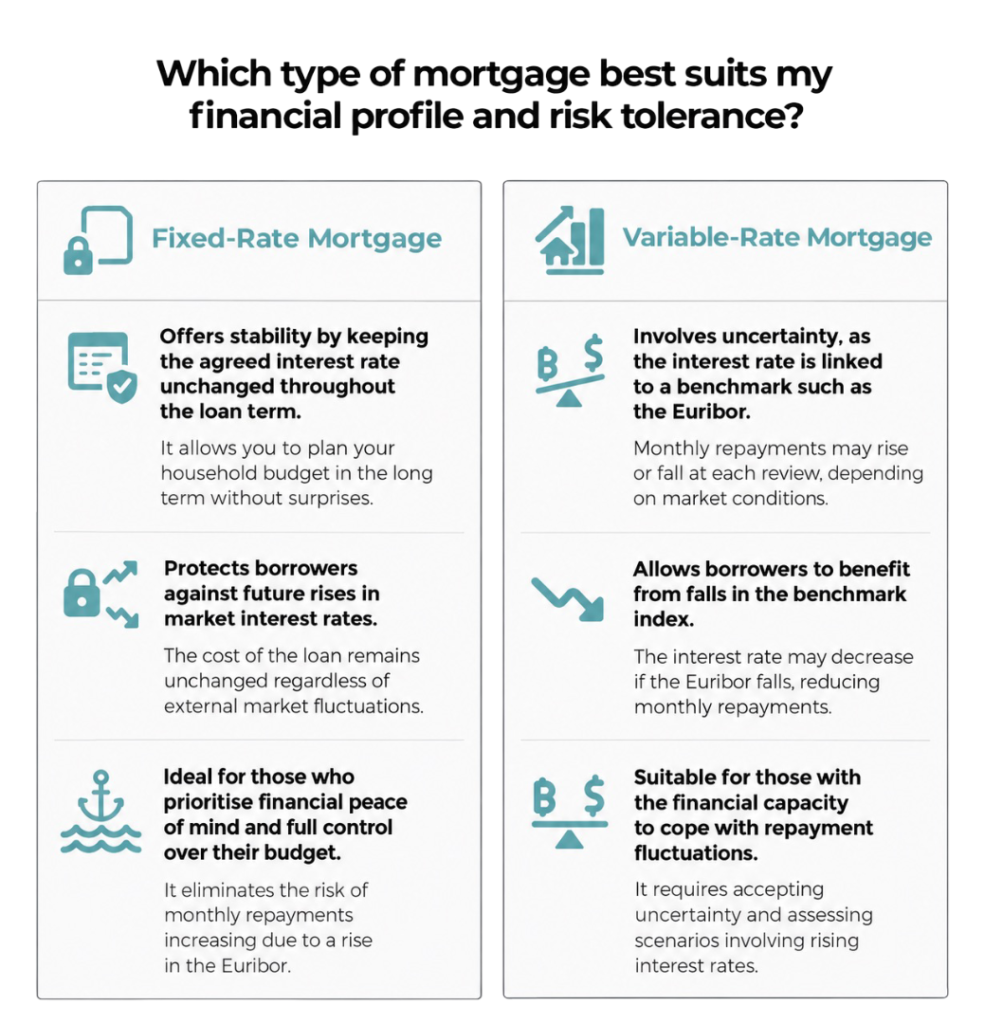
With a fixed-rate mortgage, the agreed interest rate remains unchanged throughout the loan term. This means that, provided we keep the same contractual terms, general changes in interest rates will not affect our monthly repayment.
This provides predictability. From the outset, we can know how much we will pay towards our mortgage and plan our long-term budget more easily.
With a variable-rate mortgage, the interest rate generally consists of a reference rate plus a margin set by the lender. In Spain, the 12-month Euribor is the most commonly used reference rate for this type of loan.
For example, we might come across a mortgage charging the Euribor plus an agreed margin. When the loan is reviewed, usually every six or twelve months depending on the contract, the monthly repayment will be recalculated using the relevant value of the reference rate.
If the Euribor rises, our repayment may increase. If it falls, we may benefit from a reduction.
How does a fixed-rate mortgage work?
A fixed-rate mortgage is primarily designed to provide stability.
Imagine buying a property with a mortgage over 20 or 25 years at an agreed fixed interest rate. We will know from the outset what our monthly repayment will be, provided we do not subsequently make any changes to the loan.
This predictability can be particularly valuable when we want to know precisely how much our home will cost us each month.
It also protects us against future interest rate rises. If market rates increase, our mortgage will continue to be subject to the terms we originally agreed.
The trade-off is that we will not automatically benefit from potential interest rate cuts either. If new mortgages begin to offer more favourable terms, our loan will retain its agreed interest rate unless we subsequently negotiate a change, arrange a mortgage novation or switch to another lender.
For this reason, when considering which is better, a fixed or variable-rate mortgage, we should ask ourselves how much we value the certainty of a stable monthly repayment compared with the possibility of benefiting from future market movements.
How does a variable-rate mortgage work?
With a variable-rate mortgage, we accept that the cost of borrowing may change over time.
The Bank of Spain explains that this type of financing is generally calculated by adding a reference rate to a fixed margin.
Suppose, for example, that our mortgage agreement sets the interest rate at the Euribor plus a margin. Whenever a review is due, the lender recalculates the applicable interest rate based on the reference rate specified in the contract.
This means that our monthly repayment does not necessarily remain the same throughout the life of the mortgage.
For this reason, when considering a variable-rate mortgage, we need to look beyond the initial repayment and assess whether we could afford higher monthly payments if interest rates increased.
There is specific documentation for variable-rate mortgages that uses simulations to illustrate how repayments could change under different interest rate scenarios. The Bank of Spain warns that these simulations are indicative only and should not be interpreted as predictions of future market movements.
Advantages of a fixed-rate mortgage
The main advantage is financial peace of mind. Knowing what our monthly repayment will be makes it easier to plan our household budget and removes the risk of an increase in the Euribor pushing up our mortgage payments.
This can be particularly important when borrowing a substantial amount. Even a relatively small change in the interest rate can make a considerable difference when the outstanding loan amounts to several hundred thousand euros.
For high-end property purchases, such as many of those found on the Costa del Sol, this is an especially important consideration. Taking on a change in repayments on a small mortgage is not the same as facing it on a substantial outstanding balance.
A fixed-rate mortgage also makes long-term planning easier. We can factor our repayments into our regular expenses, knowing that market fluctuations will not directly change the amount we pay each month.
However, this stability needs to be assessed alongside the price the lender charges for it.
Advantages of a variable-rate mortgage
A variable-rate mortgage has one feature that can make it attractive: the opportunity to benefit from falls in the reference rate.
If the Euribor falls and our mortgage reaches its next review date, the applicable interest rate may decrease, reducing our monthly repayment.
In addition, the initial terms offered on a variable-rate mortgage may differ from those available on a fixed-rate deal. We should therefore compare the actual offers available before ruling out either option.
However, this potential advantage comes with uncertainty.
The Euribor is influenced by multiple economic and monetary factors, and we cannot know with certainty where it will stand in five, ten or twenty years. The Bank of Spain identifies factors affecting its evolution that include European Central Bank decisions, inflation, liquidity conditions and the state of the interbank market.
For this reason, a variable-rate mortgage should be assessed against different possible scenarios rather than solely on the basis of the repayments during the first year.
So, which is better: a fixed or variable-rate mortgage?
The answer depends on our circumstances.
A fixed-rate mortgage may be more suitable when our priority is to maintain stable monthly repayments and avoid potential interest rate rises affecting our budget.
A variable-rate mortgage may be worth considering if we have the financial capacity to absorb fluctuations in our repayments and believe the lender’s terms are suitable.
We should not make our decision solely on a prediction of whether the Euribor will rise or fall.
It is impossible to predict precisely how interest rates will evolve over 20 or 30 years. A more prudent approach is to assess our own financial capacity.
We should ask ourselves what would happen if our monthly repayment increased significantly. If that scenario would put pressure on our budget, the risk should be an important part of our decision.
We should also consider how long we expect to own the property and keep the mortgage. Not everyone who takes out a 30-year mortgage keeps the same loan for the full 30 years. We might sell the property, repay part or all of the loan early, or renegotiate the terms.
The TAE can help us compare mortgages
Another common mistake is to focus solely on the interest rate advertised by the bank. To compare different offers, we need to review the terms and conditions as a whole.
The TAE (tasa anual equivalente, in English annual percentage rate) is particularly important here, as it takes into account certain fees and charges associated with the mortgage, in addition to the nominal interest rate, providing a more comprehensive indication of the overall cost of the loan.
We should also consider any linked products or services.
Some lenders may offer certain terms if we have our income paid into an account with them, take out insurance or purchase other financial products. We need to work out whether these arrangements are genuinely worthwhile and how much they will cost for as long as we keep them.
Therefore, comparing mortgages means assessing the entire deal, not just the percentage highlighted in the bank’s offer.
What is a mixed-rate mortgage?
Between fixed and variable rates, there is a third option: the mixed-rate mortgage.
With this type of mortgage, a fixed interest rate applies during an initial period. After that, the loan switches to a variable rate, usually linked to a reference rate plus a margin.
For example, we might take out a mortgage with an initial ten-year fixed-rate period, followed by a variable-rate period.
This option combines features of the other two types, but it should be assessed just as carefully. An attractive monthly repayment during the fixed-rate period does not necessarily tell us how much we will pay once the variable-rate period begins.
If we are considering this option, we need to understand which margin will apply afterwards, which reference rate the mortgage will use and how much capital we are likely to owe when the fixed-rate period ends.
|
Feature |
Fixed-rate mortgage |
Variable-rate mortgage |
Mixed-rate mortgage |
|
Interest rate |
Remains fixed throughout the loan term |
Changes according to the reference rate, usually the Euribor, plus a margin |
Fixed for the initial years, then switches to a variable rate |
|
Monthly repayment |
Stable and predictable |
May rise or fall at each review |
Stable during the fixed-rate period, then variable |
|
Impact of the Euribor |
Does not directly affect the monthly repayment |
Can increase or reduce the monthly repayment |
No impact during the fixed-rate period, but it matters once the variable-rate period begins |
|
Main advantage |
Allows us to know from the outset how much we will pay |
We may benefit if interest rates fall |
Combines an initial period of stability with a subsequent variable-rate period |
|
Main consideration |
We do not automatically benefit from future interest rate cuts |
We need to be able to afford potential increases in repayments |
We need to pay particular attention to the terms that apply once the fixed-rate period ends |
|
Predictability |
High |
Lower |
High initially, then lower |
|
Who it may suit |
Those who prioritise stability and control over their budget |
Those who can absorb fluctuations and accept interest rate uncertainty |
Those who want stability during the initial years and are comfortable with a variable rate afterwards |
|
What to compare |
Nominal interest rate (TIN), TAE, term, fees and linked products |
Margin, reference rate, TAE, review frequency, fees and linked products |
Length of the fixed-rate period, initial interest rate, subsequent margin, TAE, fees and linked products |
What should we consider before choosing a mortgage?
Before deciding which is better, a fixed or variable-rate mortgage, we need to understand our own financial figures.
First, we should establish how much we need to borrow and what percentage this represents of the property’s value. We should then work out what monthly repayment we can comfortably afford without compromising the rest of our finances.
We do not recommend assessing our financial capacity based solely on the most favourable scenario.
Owning a property involves costs beyond the mortgage itself, including taxes, service charges, utilities, insurance, maintenance and potential repairs. Properties in premium residential developments may also come with additional services, facilities and community fees that need to be included in our budget.
The goal should not be to establish the maximum monthly repayment we can afford, but to find a financing structure that allows us to enjoy the property while maintaining a comfortable financial position.
Mortgages and buying property on the Costa del Sol
When buying a property on the Costa del Sol, particularly a second home or a premium property, or when purchasing as an international buyer, financing should be considered an integral part of the transaction.
The mortgage amount, the tax implications of the purchase, the capital we want to retain after completing the purchase and our medium- and long-term plans are all interconnected.
For this reason, it is advisable to explore financing options before making a final commitment to a property.
At RH Privé Estates, we view buying a home as a complete process. Our work goes beyond showing properties: we aim to understand the type of home each buyer is looking for and support them through the different stages of the purchase.
We have strategic partnerships with leading banking institutions to simplify every stage of the process for our clients. All the banks we work with have dedicated departments specialising in assisting international clients. These teams provide support in clients’ own languages and offer exclusive benefits to RH Privé clients, which are also available to Spanish property owners. Don’t hesitate to speak to one of our sales agents for personalised advice.
A successful property purchase starts with finding the right home, but it also means approaching the transaction with all the information we need.
Frequently asked questions about fixed and variable-rate mortgages
Which is better, a fixed or variable-rate mortgage in 2026?
Neither option is automatically better for every buyer. A fixed-rate mortgage provides stable monthly repayments, while a variable-rate mortgage allows us to benefit from potential falls in the reference rate but also exposes us to the risk of future increases. Our decision should be based on the specific terms available and our financial capacity.
What happens to a variable-rate mortgage if the Euribor rises?
If our mortgage is linked to the Euribor, an increase in the index may raise the applicable interest rate at the next review and, consequently, increase our monthly repayment. The extent of the change will depend on the outstanding balance, the remaining term, the margin and the terms of the contract.
What happens if the Euribor falls?
A fall in the Euribor may reduce the interest rate applied to a variable-rate mortgage at the next review, lowering the monthly repayment in accordance with the terms of the loan.
Do I always pay the same monthly repayment on a fixed-rate mortgage?
In terms of the interest rate, the defining feature of a fixed-rate mortgage is that the agreed rate remains unchanged throughout the life of the loan. This provides stability against general interest rate fluctuations. However, we should still review all contractual terms and any associated financial products.
Which mortgage carries more risk: fixed or variable?
A variable-rate mortgage introduces greater uncertainty about future monthly repayments because it depends on a reference rate. A fixed-rate mortgage removes this particular risk associated with interest rate movements, although we still need to compare the costs and specific terms of each offer.
Is a mixed-rate mortgage worth considering?
It may be suitable in certain circumstances, but we need to assess both the initial fixed-rate period and the terms that will apply when the variable-rate period begins. A mixed-rate mortgage should not be judged solely on the repayments during its first few years.
Should we choose a mortgage before looking for a property?
It is not essential to have a mortgage in place before starting the property search, but it is advisable to understand our budget, borrowing capacity and the financing terms we may be able to access. This allows us to look for properties within a realistic price range and approach a potential reservation or negotiation with greater confidence.
